Framförhållning

Dem varnade mig, mina kollegor. När jag började arbeta på idrifttagningsavdelningen  så hade jag tanken att nog var utlandsresorna allt strukturerade, planerade och… I fredags när jag kom till kontoret möttes jag av ett 20-tal mejl, varav ett löd:

”Planera in detta. – Kundmöte i England nästa vecka.”

Lånad @ office.microsoft

_______________________________________________________________

They warned me, my colleagues. When I first started working at the commissioning department I was well aware that it involved a lot of travel. However, I had the (somewhat naive) thought that the travels abroad would be structured, well planned and… This friday when I came to the office I was met by a 20 or so letters; one read:

”Plan this. – Customer meeting in England next week.”

Bokhyllan | Empires of Light

Jag älskar att läsa engelska naturvetenskapliga texter – speciellt från USA. Det gäller inte bara ”populärvetenskapliga” böcker, även kurslitteratur är betydligt bättre – både i upplägg och innehåll. Amerikanare vet hur man gör ett ämne intressant.

För ett tag sedan beställde jag hem Empires of Light – Edison, Tesla, Westinghouse and the race to electrify the world, skriven av Jill Jonnes (Amazon).

Boken är både en historisk återberättelse av det så kallade ”War of Currents” men innehåller samtidigt mycket lärorik beskrivning av Elkraft som vetenskap. Jag har ännu inte läst klart boken, i det närmaste bara börjat, men jag har redan funnit ett utdrag ur boken som jag känner belyser det som jag så gärna vill lyfta fram – att kunskap kan vara intressant, lärorikt och riktigt spännande.

_________________________________________________________________

Utdrag ur Empires of Light av Jill Jonnes eller:

Faraday, and how continuous current was ‘created’ through magnetism

Faraday had an iron ring. On one side he had wound a coil of insulated wire that was attached to a battery. On the other side of the ring he wound a second coil of insulated wire, and that was attached to a galvanometer, which measures small electric currents. When Faraday activated the battery to electrify the first coil, he looked hopefully for signs of life in the second coil but saw none. What did catch his eye was that the galvanometer registered a feeble and momentary current when the battery was attached or detached. Here was the first clue: A change in the charged coil’s magnetic field – starting and stopping it by activating the battery – briefly created current in the second wire coil. Faraday’s friend and colleague John Tyndall would later ponder Faraday’s genius and explain it thus:

“He united vast strength with perfect flexibility. His momentum was that of a river, which combines weight and directness with he ability to yield to the flexures of its bed. The intentness of his vision in any other direction did not apparently diminish his power of perception in other directions; and when he attacked a subject, expecting results different from those which he expected should not escape him through preoccupation.” […]

Over the next couple of months, as autumn brought the usual rain and gloom to London, Faraday found a day here and there to pursue these intriguing blips by the galvanometer. In his first experiment, he wound a coil of wire around a straight iron core. He took two long bar magnets and held them in a V and used the wrapped iron core as the third side of the triangle. When the V of the magnets was separated, breaking the magnetic circuit, current was induced in the coil. [Faraday noted] in his journal, “Hence, distinct conversion of Magnetism to Electricity.” To further test this, he took a pencil-shaped magnet and simply moved it in and out of coiled wire. The moving magnetic field created a brief current in the wire. But Faraday was interested in producing a continuous current, not just brief bursts.

So he set up a simple twelve-inch copper disk on an axle that revolved between the opposite poles of a permanent magnet. On one side of the copper disk, a wire ran from the axle to a galvanometer. Then another wire led from the galvanometer to a metallic conductor held against the rim of the copper disk. When the copper disk revolved, disturbing and thus changing the magnetic field of the magnet, the galvanometer registered a continuous electric current. [Faraday wrote] in his minutely detailed laboratory notebooks, “Here therefore was demonstrated the production of a permanent current of electricity by ordinary magnets.” Simply stated, Faraday’s law of electromagnetic induction says that an “electric current is set up in a closed circuit by a changing magnetic field.”

Improvement of Commutation Failure Prediction in HVDC Classic Links

In this thesis, an evaluation of the existing control system for ABB: s HVDC Classic Links is performed in order to investigate whether a possible improvement to commutation failure prediction is possible and to be recommended.

The thesis starts with a theoretical approach to the complexity of consequences of increasing the extinction angle (γ) in order to prevent commutation failure in inverter operation, which is later confirmed through using the simulation software PSCAD to evaluate coherence between simulation results and theory.

Dynamic power studies are performed through simulations in the electromagnetic time domain transient tool PSCAD in order to establish a possible improvement to the existing commutation failure prediction today used in ABB control systems for HVDC applications.

The thesis shows three possible detection signals to quickly detect increased risk for commutation failure within 1 ms after fault initiation. It addresses issues of network strength and robustness. The detection can be made by utilizing existing control system signals for recording zero-crossing times of the valve voltages, the sum of the AC voltage phases and to detect phase shifts using the error signal of the internal PLL-algorithm.

Several points of interest are presented in the thesis for a successful implementation of an improved predictor algorithm. Simulations show how there are limits to when an angle increase may be effective concerning point-of-wave of the AC voltages as well as point-of-wave in the extinction angle (γ) transient, where an effective use of an improved predictor is limited to areas between 0-54º and 144-216º on the AC voltage cycle.

The extent to which an extinction angle (γ) contribution is effective without giving consequences which leads to network collapse is highly related to the strength of the connected AC system and there might be applications in which an increase in (γ) is not to be advised.

_________________________________________________________________

My Bachelor’s thesis was approved by University West, 17th of March 2011. The electronic publication can be found in full text at the DiVA database for academic papers in the coming weeks.

Tacka geten för kaffet!

Dricker du en kopp kaffe varje dag? Kanske två? Själv dricker jag åtminstone tre koppar om dagen och jag skyller på arbetet! Vore det inte för den rutin som existerar på jobbet (och som jag så snabbt omfamnade) så hade jag nog stannat vid en kopp lite då och då.

(c) Johanna Ivarsson, 2010

Jag har snabbt märkt att tiden det tar för datorn att starta upp efter inloggning sammanfaller utmärkt med tiden som det tar att hämta en kopp kaffe från fikarummet. Visste du kanske att vi svenskar dricker flest koppar kaffe i hela världen? Jag har också hört att amerikanskt kaffe smakar som té med kaffesmak… inte för att jag har testat, men det låter riktigt otrevligt.

Jim Al-Khalili gör en kort utläggning i sin bok Pathfinders om kaffets historia. Att kaffe som vi ser det idag härrör från arabvärlden. Men tydligen kan dess ursprung spåras tillbaka till Etiopien och 1000-talet där sägnen säger att en arab vid namn Khalid en dag observerade hur hans getter blev livligare efter att ha ätit bönor från kaffeplantan. Av ren fascination tog han ett par kaffebönor och kokade dem i vatten: den första koppen kaffe var producerad. Inte långt senare hade kaffet spridit sig till flertalet länder i arabvärlden… and the rest is history, som man säger.

Så vad vet jag, arabiskt kaffe är himla gott – men tacka vet jag getterna!

Att skapa ett hem.

Att ta examen och börja ett nytt jobb för mer med sig än blott en ny arbetsmiljö. I början av februari flyttade jag och sambon till Västmanland – här bygger vi vårt nya hem.

Efter att ha bott i en studentlägenhet (basinredd) i tre års tid så är det en markant skillnad att sedan finna sig i ett hus – hur skall vi fylla alla rum? och kostnaden sen? Nåja, nu hade vi faktiskt enormt mycket tur eftersom mina svärföräldrar visade sig ha ett halvt hus (mer eller mindre) ståendes nere i källaren (Tack!).

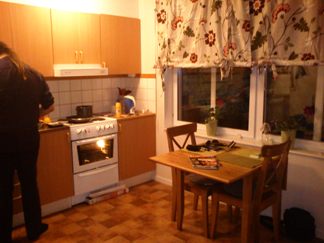
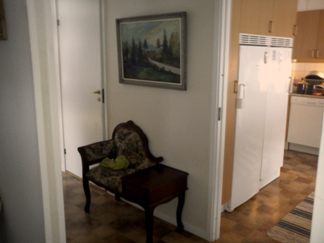
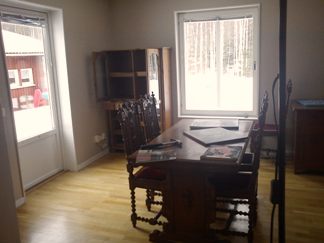
Igår kom dem med ett flyttlass och vi spenderade en trevlig kväll tillsammans. Och visst börjar vårt nya hus se ut som ett riktigt fint hem..? Bit för bit.

This website is Protected by wp prevent copy